Chapter 04 / 06 · 1920s
The Refugee
To Lose and to Rebuild
Asia Minor Catastrophe
- Reference
- HH·04
- Model
- Maria Blizioti
- In the family
- Grandmother, remembered as a young refugee
- Themes
- Loss, dignity, and rebuilding
- Sculptural precedent
- Michelangelo’s Rondanini Pietà (1564); Castello Sforzesco, Milan
- Completed
- 2024 · Version III
- Medium
- Mixed media: a 3D-printed recycled PETG body, epoxy clay, metal powders applied with resin and catalyst, pigments, acids, and a protective topcoat.
- Dimensions
- 82 × 55 cm, height × diameter
The person behind the portrait
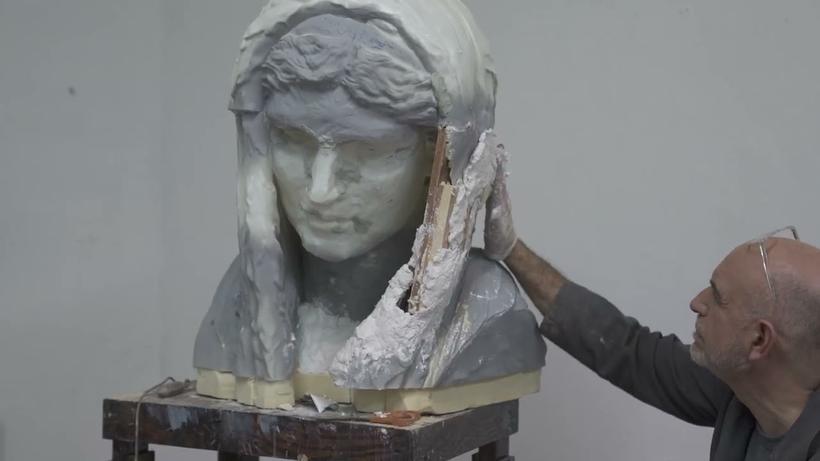
The Refugee draws on the memory of the artist’s grandmother, Maria Blizioti, who was displaced from Asia Minor as a young woman. Her experience connects the catastrophe of 1922 with the lives of later generations.
The sculpture holds loss and dignity together. A monumental adaptation, Refugee—Woman of Smyrna, stands in Athens in a neighborhood shaped by the refugees’ arrival.
The films
Films retain their original audio. Where YouTube supplies captions, use the CC control. The text on this page introduces the sculpture and its historical setting.
Views and surface details
Select an image to see it in full.
History and inspiration
The destruction of Smyrna in 1922 and the subsequent compulsory population exchange uprooted communities on both sides of the Aegean. Refugees arriving in Greece had to build new homes, livelihoods, and social ties.
Michelangelo’s late, unfinished Rondanini Pietà offered a sculptural language for grief and vulnerability. Petrides brings that emotional weight to one woman’s face, keeping the individual visible within a vast historical event.
Read the full catalog chapter (English)The artist’s words (English)
"My maternal grandmother fled burning Smyrna as a young woman in 1922, during the Asia Minor Catastrophe. She lost a prosperous home in a cosmopolitan city and arrived in Greece to compatriots who were not very welcoming. She married and had seven children, of whom five survived into adulthood. Later in life she lived at different times with different children, including with my parents and me in the New York area. She said little to me about her experiences, and yet, being a sensitive type, I intuited a great deal. She was a true stoic in the years I knew her.
As to the sculpture The Refugee, I sought to convey her emotions around September 1922 when she was escaping her burning home and was arriving in Piraeus, the port city of Athens. I sought to convey shock as she experiences the pain and extreme loss—she does so quietly, with dignity.
The Hellenic Head you see in the exhibition was enlarged and adapted into a monumental public sculpture to mark the centennial of the destruction of Smyrna. Refugee—Woman of Smyrna was unveiled in September 2022, in an Athenian neighborhood shaped by refugee history. Viewers have told me they see their own grandmothers in her face. I can think of no higher compliment."
Get in touch
For exhibition partnerships, loans, collecting, press, or a visit, write to the studio.
Email the studio studio@petrides.art